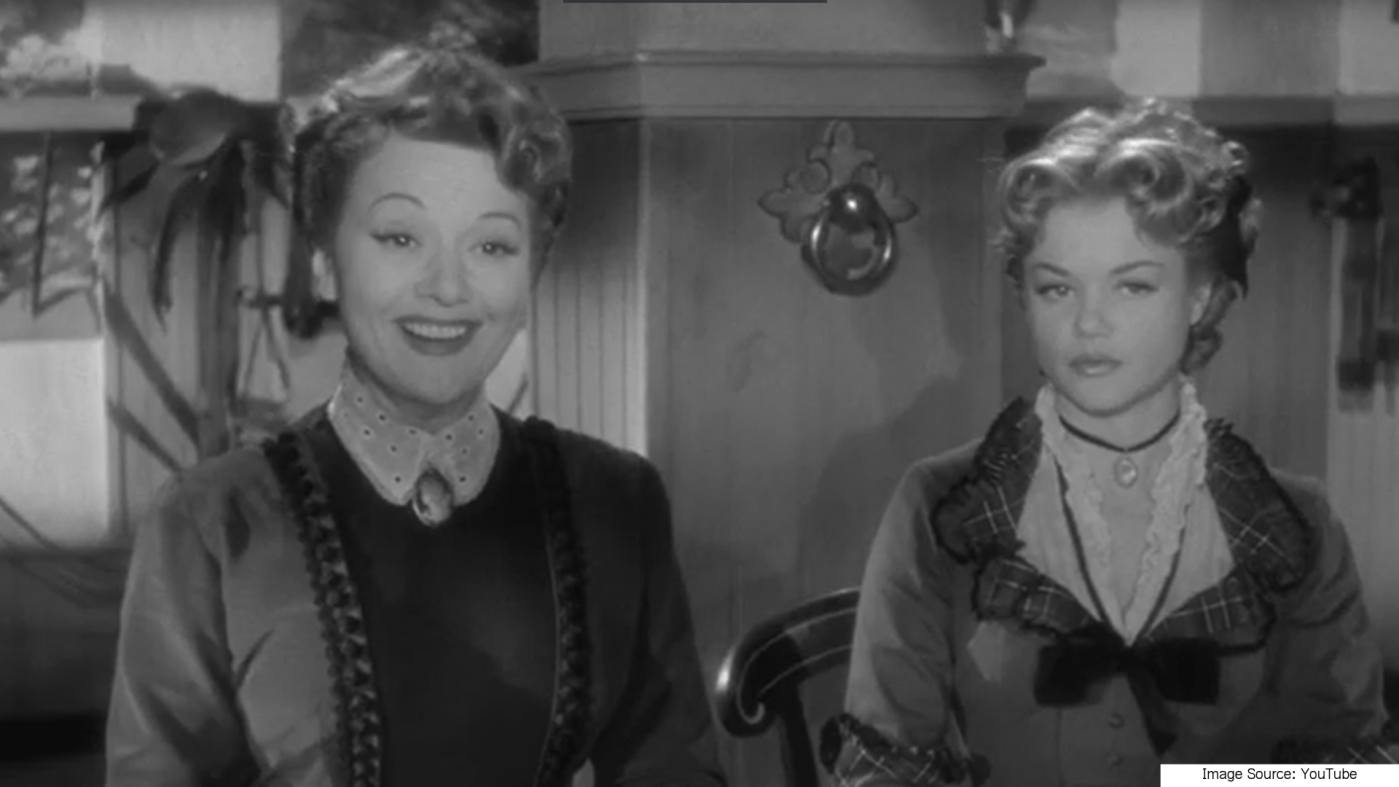
This is the fourth in a series of five essays about Olivia (1951). These essays are based on personal reflections, research, and observations related to the film. I offer these words only in appreciation of the film and those who made it.
The core issue in Olivia, save for Olivia’s love sickness, is that neither Julie nor Cara are particularly careful about how and where they seek love and validation.
Both rely on being exalted—we see this play out in their relationships with the girls at the Les Avons. While Cara prefers students to fawn over and serve her, Julie likes to remain aloof and unreachable enough that any proximity to her is a reward itself. Olivia is frequently invited to sit at Julie’s right hand: it’s a status to be earned and maintained, fueling an atmosphere of competition among anyone who might want that position. Cara wants it, too, and believes that acting out is enough to secure Julie’s attention.
In one scene, where Julie and Cara are sitting in the dining room, Julie asks Cara how she slept only to be met with a slew of complaints which Julie quickly tries to remedy. Julie asks Cara if she would like to go for a walk—a concession for a night of poor sleep and its resulting bad temperament. Cara’s mood is lifted and Julie appears to feel a flutter of hope at this only for it to be dashed by Frau Riesner who interjects to say that a walk outside is against medical advice. This interjection from Frau Riesner establishes one of two love triangles driving this story.
A second triangle is established when Olivia, having witnessed the inner workings of the first triangle on display, makes herself a party to it by discussing it with Signorina Baietto. Here, Olivia expresses concern about Cara’s emotional instability and it is in this instability that Olivia finds her pathway to a deeper relationship with Julie. That pathway is blazed wide open when Julie invites Olivia to sit next to her in the library, and the connection between the two is reinforced when Julie welcomes Olivia to sit next to her at mealtime, which becomes another opportunity for Cara to cause a stir.
Although Cara seems to believe her behavior will draw Julie closer, it only serves to divide them since Frau Riesner is always ready to step in even when she’s not needed. There’s a tension here between what this character truly desires (to love and be loved as once was the case) and how she goes about achieving that desire. Julie’s behavior follows the very same pattern.
We consistently see Cara publicly vie for Julie’s attention, only for Julie to turn to Olivia or her own right hand Signorina Baietto or some other recipient more willingly adoring and loyal. Enter Frau Riesner who responds to Cara’s every whim, every need while Julie stands by helpless due to the intrusion (that she herself invited into the situation by hiring Frau Riesner in the first place). It’s a hard pill for the audience to stomach because, if we know anything at all, it’s that Julie is not as helpless in these matters as she seems.
Julie herself recounts for Olivia how she painstakingly cared for an ill student until she was well again—clearly a more dedicated effort than what we see her put forth for Cara who must rely on staff and students to attend to her needs. And how that effort paid off: the once ill student, nearly gasping at the sight of Julie, approaches her with all the love and admiration that Julie aches to receive from Cara. Here, we see how attentive a partner Julie might have once been to Cara and how that attentiveness, when applied to the students in her charge, might’ve created a distance between the two headmistresses. The scenario with the former student repeats itself at the end of the film when Julie finds Olivia holding vigil at her door as she mourns Cara’s death. Julie drops everything, even her own vigil over Cara, to make sure Olivia is well.
In essence, we see Julie go on living in spite of the love lost between herself and Cara: she still has her students, her trips to Paris, her social life. She’s unwilling to sacrifice any of these things to ensure Cara’s health. Julie—secure in the knowledge that Signorina Baietto and Frau Riesner and others can adequately care for Cara—puts herself and her desires first.
In other words, she wants Cara well again but not if she herself must be bothered with it. Yet, she still resents that others have taken her place without any awareness or acknowledgement that Cara has also been replaced (by Olivia and by proxy) in her own heart.
As easy as it is to villainize Cara because of her hysterics and clear resentment of Julie, Julie proves that she is no saint in this union either. Both of them rely on others to validate and meet their emotional (and in some cases, physical) needs, which demonstrates a selfishness on both counts, as well as a reluctance to reciprocate the love that is given to them. Julie redeems herself only because she loses so much and in that loss, recognizes that she is powerful enough to cause irreversible damage to those for whom she has affection.
 Des Chimères
Leave a comment