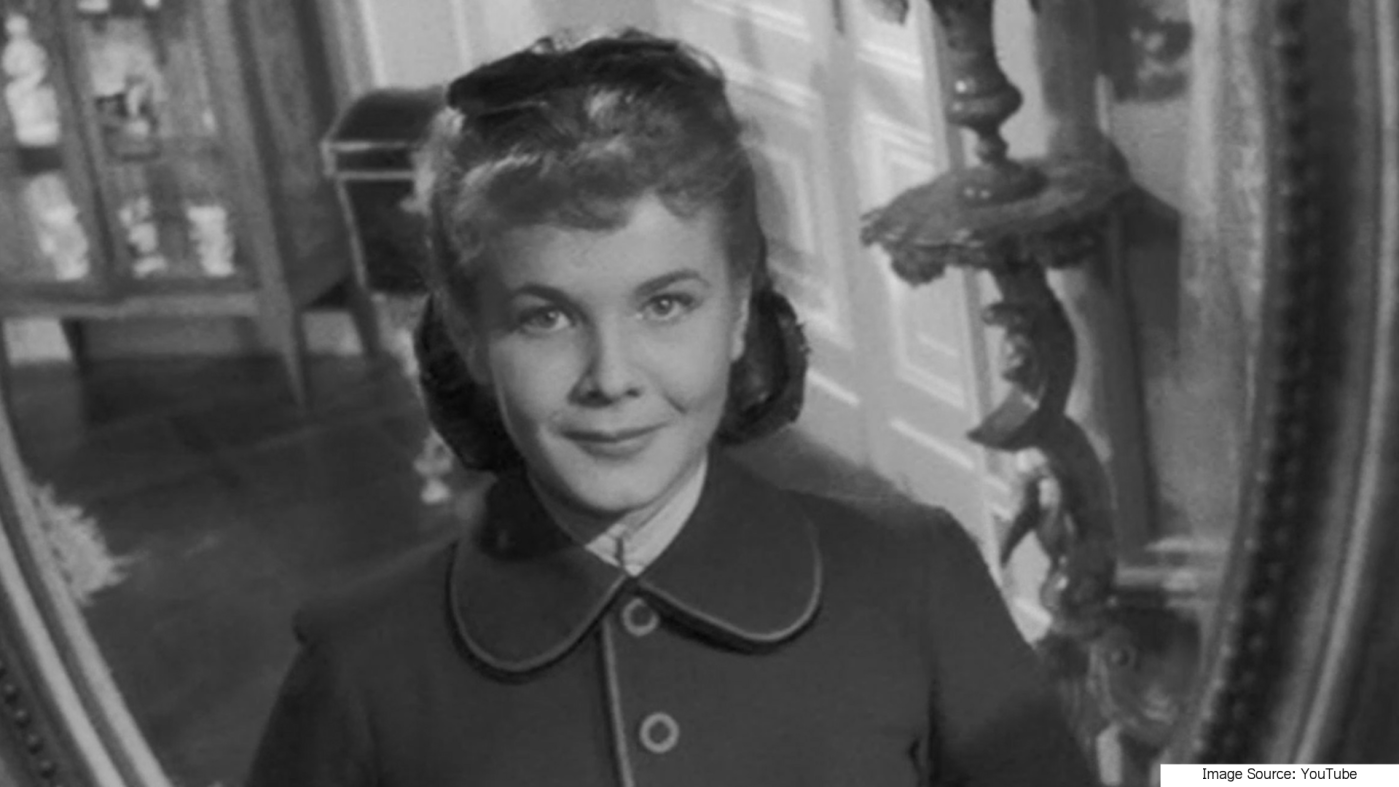
This is the first in a series of five essays about Olivia (1951). These essays are based on personal reflections, research, and observations related to the film. I offer these words only in appreciation of the film and those who made it.
Olivia. It’s a name that lovers of queer cinema have long heard echoing in the depths of their ears. And for good reason: the velvety voice of Edwige Feuillère is hard to forget. For nearly a century, that voice has elicited in audiences a shiver of the spine, a flutter of the heart, a quiver of the legs. It’s a voice that permeates the 1951 film in which she speaks this name and does to its target much the same as it has done to the countless women (and men, of course) who’ve come to know it.
The film, also called Olivia and directed by Jacqueline Audry, follows the story of sixteen-year-old Olivia Dealey (Marie-Claire Olivia) as she enters Les Avons, a girls’ boarding school on the outskirts of Paris. There, she discovers the woes of first-time love when her youth and intellectual promise draw headmistress Mademoiselle Julie (Feuillère) away from her own long-time love Mademoiselle Cara (Simone Simon). Olivia’s mere presence creates such an irreparable break in Julie and Cara’s passionate yet fading relationship that one supporting character likens their eventual separation to a “divorce.”
Bold moves for a film made in 1951! Though the film has long been considered a landmark in lesbian representation (there’s even a lesbian cruise line named after it), modern-day viewers are solidly focused on the taboo nature of the student-teacher storyline. Many find Feuillère’s Julie far too suave, far too predatory to take Olivia for what it was at the time of its release: an incredibly daring and frank film about queer love in one of the few settings where heteronormative expectations couldn’t be thrust upon its main characters.
But those who do find resonance in the film do so not because it offers something forbidden to consume, but because there’s a complexity in the story that speaks to the truth of what it means to learn, love, and live as a queer woman. Today, there are social media accounts and Discords inspired by the film. Some write fan fiction to explore their connection to the film, others spend their days writing blog posts about it (ahem). More people are talking about Jacqueline Audry and Edwige Feuillère now than there have been in decades. Seventy years later, Olivia is still a source of intrigue, despite the general audience’s discomfort with its premise. The same is true for me.
I first saw Olivia in 2007 or 2008. At the time, I had only just found the courage to part ways with my own predatory teacher—one who kept close tabs on me even as I entered college. Having no frame of reference for this experience, I turned to film and, like many in a situation like mine, first discovered Géza von Radványi’s 1958 remake of Mädchen in Uniform. The premise is similar to Olivia: at an all-girls boarding school in Prussia, Manuela von Meinhardis (Romy Schneider) finds affection and affinity with her teacher Fräulein von Bernburg (Lilli Palmer). In comparison to Olivia and in spite of itself, Mädchen in Uniform is a relatively wholesome film. Though the teacher exhibits a few lapses in judgement, she is presented as fair and well-intentioned at every turn of the story, most of all toward the student for whom she harbors the most affection.
Something about that telling of the story—my story—really struck a nerve and prompted countless questions. What was it about Fräulein von Bernburg that made her such a good, decent, sanctified egg? What in her unique chemistry kept her from swaying too far from the beaten path? Why hadn’t my own teacher possessed such a steadfast moral compass? And then I watched Olivia.

At first, Olivia too closely resembled what I experienced for me to take it at face value, and I was still so close to that experience that I couldn’t separate it from the film. But still, there was something in the way the student is completely undone by her teacher’s plays for her affection, and how effectively the teacher both exploits and denies her affect on the student that spoke to me. And then, of course, there was Edwige Feuillère. (More to come on her in another post.)
Between 2008 and 2019 (when the film was restored and re-released), I revisited Olivia only a handful of times, if only to revel in the intelligence and perfection of Feuillère’s performance. By 2014, I began developing a narrative in my head around what this film was really trying to say about the persistent challenges of life as a queer woman in both 1950s when Olivia was made and at the end of the 19th century when it is set. Those challenges, presented to the audience in the context of a student-teacher relationship, are communicated as not only ongoing and expected, but something to be passed from one queer generation to the next. Coming up against such challenges is, in the context of Olivia, an inescapable fact of queer life.
In this series of essays, I will explore these ideas at length, making the case for Olivia to be seen not as a film condoning Julie’s actions, but as a film that portrayed what has proven to be a universal and timeles queer experience in spite of the social and cinematic constraints of the time.
To be completely honest, I wasn’t going to write this introductory essay. Initially, I believed that a mere viewing of Olivia would be enough to ground the four remaining essays in this series. But as I read over my drafts, I recognize that part of my goal here—in addition to putting a different lens on Olivia—is to understand Julie’s motivations and, in turn, understand the personal experience that I bring to viewing the film. I seek to understand Julie because I also seek to understand the teacher who did these very things to me. Though I know that true understanding is not and never will be achievable, examining a narrative outside of my own brings new insights I believe are worth considering. And so, I watch and reflect and write in the hope of stumbling upon new, eye-opening truths.
While these essays go well beyond myself and my own experience (in fact, only this first essay includes personal anecdotes), I wanted to at least acknowledge where I stand in relation to this story, why it sticks with me after so many years, and why I put forth the effort of writing five lengthy essays about a single 90-minute film. I hope you read this series with that in mind and I hope that something here resonates with you, dear reader, even in some small measure.
Watch the trailer for Olivia:
 Des Chimères
Leave a comment