A few months ago, a colleague asked me why film is so important to me. Caught off guard by the question, I gave a jumbled response, alluding to the insight one can glean about historical events by the way a film depicts them. I’m not entirely sure why I offered this explanation for my investment in film. I suppose it sounded good in the moment. It’s not entirely untrue—I do appreciate, for example, looking at Depression-era MGM films and recognizing that the opulence of those films is in direct contrast with the daily lives of their audience. But the truth about my love for film is much more fundamental than that.
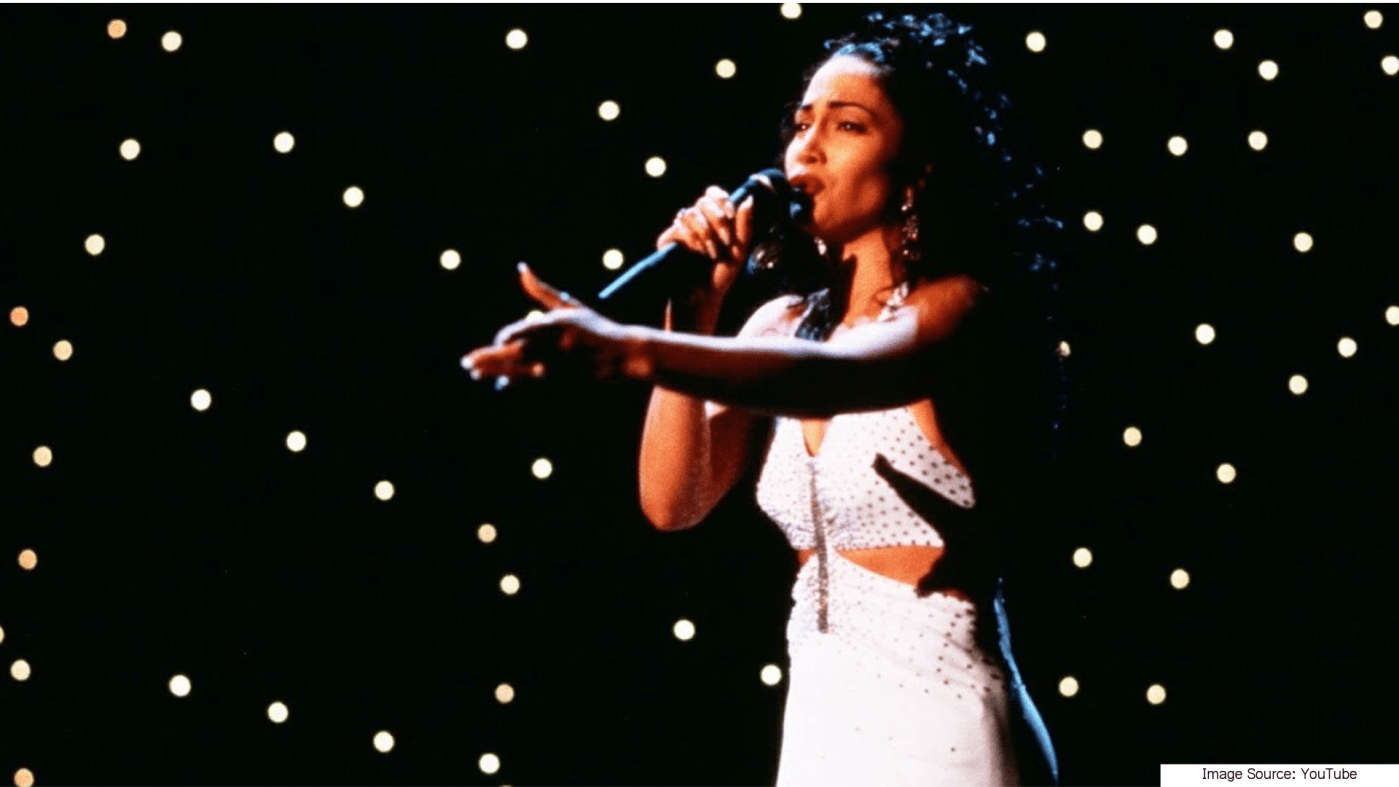
I was 10-years-old the first time I saw someone who looked like me on the big screen. The film was Selena and I felt like an audience of one in a crowded theater on that March afternoon in 1997. I was in awe of this young woman’s story and utterly fascinated by how closely her Mexican-American family resembled my Puerto Rican one. Three generations of my family went to see Selena that day, and if I had to guess, I’d bet it was their first time in a long while seeing themselves on a thirty-foot tall screen, too.
This month marks the 24th anniversary of the release of Selena (and the 26th anniversary of Selena Quintanilla-Perez’s death) and, to this day, it’s hard to put into words what it unlocked for me. I hadn’t ever heard of Selena before I saw the film and it was initially confusing to me that my parents and grandmother wanted to spend money to go see it. But I’m glad they took me. I’m glad I paid attention. That day in March over two decades ago changed how I saw myself and my family entirely.
I distinctly remember leaving the theater and somewhere in the darkness behind me, I heard my grandmother—a woman I didn’t know well and who, to me, seemed rather unemotional—suppress a sob. Something in the story had clearly resonated. Minutes later, while waiting for my mother in the bathroom, I really looked at myself in the mirror for what seemed like the first time in my young life and dared to think that I, too, could be Selena. No, I didn’t have her look, or her voice, or any of the iconic markers that so many associate with Selena today. But there was a connection. I felt it.
Almost immediately, it seemed, I was begging my parents to buy Selena’s music for me. I’m certain now that they were perplexed by my interest in Tex-Mex music—I was neither Tex nor Mex, nor was I particularly aware of my own Nuyorican origins. Selena’s music sounded nothing like the 90s House music my older siblings so loved, or the Salsa I sometimes heard my dad play on weekends. To make matters even more perplexing, I didn’t even know Spanish.
But I was determined to learn.
With a diligence I’ve not been able to match since, I wrote every Selena lyric and its translation in a composition notebook. I carried the notebook with me everywhere and read along as I listened to Selena sing. I did this until I learned everything by heart.

This years-long endeavor opened up the world to me in a way I couldn’t have imagined prior to embarking on it. Not only did Selena’s music help me become familiar with a language I often heard spoken in murmurs and whispers at home, but it also instilled in me an appreciation for all languages and cultures that continues to this day. It’s the reason I excelled in Spanish at school, mustered the courage to sing in Spanish in community talent shows, and branched out to learn and develop an ear for French and German. The love for languages that started with Selena transformed itself into a passion for foreign language films and a curiosity about my own family history. I know now that my unflinching grandmother who stifled a cry at the theater that cool, sunny day in March 1997 experienced a tremendous amount of loss in the early part of her life. Is it so strange, then, that a film about a promising life cut short would break even the most hardened of humans? No. But that’s the draw of Selena, both the person and the film.
The film, though not typically remembered for its cinematic excellence, stands the test of the time: few films before or since have depicted a Latino family as authentically as that one and people everywhere, no matter their age, still quote the film’s most famous line.
“Anything for Salinas.”
In a way, this line predicted what was to come. The Quintanilla family has truly done anything and everything to solidify Selena’s legacy. And Selena’s music and memory have become ingrained in our culture because of their unwavering dedication to her. People from all walks know her, know her music. Everyone from Samoan actress Frankie Adams to Bronx-born rapper Cardi B has paid homage to Selena. Toddlers are belting out her songs (in Spanish!) on social media. Selena’s life story, now a popular Netflix series, is as familiar to music lovers as that of Kurt Cobain, or Aaliyah, or any other distinctly American music story that reminds us that tomorrow isn’t always promised. To see so much genuine love and respect for the person whose music and influence helped shape my life moves me deeply. No longer am I the lone fifth grader obsessing over Spanish-to-English translations while my peers squabbled over which Spice Girl was the best one (it was Geri, by the way).
I can’t write about Selena in good conscience without acknowledging the impact of Jennifer Lopez’s performance on both the film and on the Latino community. Lopez more than did her homework for this role. She stepped into the shoes of an icon in the making amid backlash about her origins and made the very best of it: she captured Selena’s humble spirit, alluring charisma, and love for performance and made people yearn for more. She did so much more than that, too. For so many young Latinas, she was one of the first faces we came to identify with and take pride in. What Maria Montez, Rita Moreno, and Rosie Perez did for our parents and grandparents, Jennifer Lopez did for a new generation.
As for me, Selena came at a time when I was just becoming aware of the intersections of my Latinidad and my Americanness, and understanding that I needed to somehow reconcile both of those identities. What Lopez gave of herself in Selena helped me feel less alone in that journey. That’s the power of film. And that, my friends, is why I love it.
Watch the Selena trailer:
 Des Chimères
Leave a comment